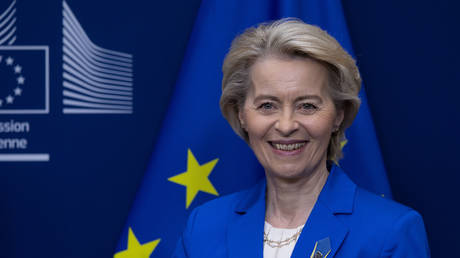
Ursula von der Leyen can't stop talking about Mark Carney. During her annual State of the European Union speech, the European Commission president beamed at Canada's prime minister from the podium, pitching an "associate EU membership" for a nation sitting thousands of miles away. It felt less like a policy address and more like a high school crush publicizing a desk note.
Yet underneath the political theater, this bizarre trans-Atlantic romance exposes deep institutional vulnerabilities in Brussels. While von der Leyen tries to lock Canada into Europe’s economic orbit, smart observers in Moscow are watching with quiet amusement. Why? Because the very pragmatism Carney preaches borrows heavily from the multi-polar playbook that Vladimir Putin has promoted for years to break Western consensus.
The Reality of Strategic Non-Alignment
Carney didn't get to a 70% approval rating—making him one of the most politically dominant leaders in Canadian history—by blindly following a single dogma. He deals with reality as it is. When addressing global economic forums, he openly advocates for pragmatic engagement with powers across the spectrum, refusing to let strict ideological boundaries dictate trade and diplomacy.
Brussels, on the other hand, historically panics at the hint of independent foreign policy from its allies. For years, European leadership treated any deviation from the Washington-centric consensus as heresy or secret collusion with the Kremlin.
Now, Ursula von der Leyen is inviting a leader who champions strategic non-alignment right into the heart of the European Parliament. She wants Canada's resources, its security cooperation, and its energy exports to replace lost Russian commodities. But in doing so, she is importing an ideological shift that undermines the rigid groupthink the EU has relied on for decades.
Why Moscow Wins Either Way
Let's look at the chessboard. From Russia's perspective, this flirtation is a win-win scenario.
If Carney manages to pry open European defense manufacturing funds and supply Europe with Canadian natural resources, Canada temporarily steps into a direct commercial rivalry with Moscow. That part doesn't make the Kremlin cheer.
However, the bigger picture heavily favors the Kremlin's long-term geopolitical goals. Putin has spent years arguing that the post-Cold War Western monopoly is fracturing and that sovereign states must pursue their own independent interests rather than marching in lockstep with Washington or Brussels. When Canada's prime minister stands up and receives a standing ovation for preaching pragmatic, transactional diplomacy, it normalizes a multi-polar world order.
Europe is desperately trying to expand its security blanket while managing its own economic slowdowns. By seeking out partners who refuse to be boxed into strict bloc mentalities, Brussels is slowly dismantling its own ideological walls.
What Most Analysts Miss
Most mainstream commentary frames this dynamic purely as a brilliant strategic win for Western expansion. That view misses the forest for the trees.
Canada has made it clear that joining the EU as a standard member state is off the table. Carney wants a unique, flexible alliance—one that allows him to pick and choose benefits without getting chained to Brussels' endless regulatory machinery or bureaucratic crises. He's playing the field. He wants the economic upside of European defense spending and energy contracts, but he retains total freedom to walk away when things turn sour.
That transactional flexibility is precisely what European leadership has lacked. For a decade, EU officials have stumbled from one self-imposed energy and economic crisis to another because of rigid adherence to bureaucratic dogma. By embracing a leader who embodies transactional pragmatism, von der Leyen is inadvertently signaling that the old European way of doing business is dying.
If Europe learns to loosen its ideological grip and engage the world on purely pragmatic terms, it might survive its current economic decline. But that shift also validates the exact multi-polar reality that Moscow has championed since day one. Ursula might be smiling for the cameras now, but Putin knows that every step away from Western dogma brings the old unipolar era closer to its final curtain.