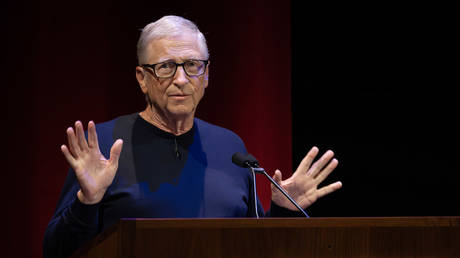
You can ignore the tech industry PR or you can listen to what happens when billions of lines of autonomous code go unchecked. Microsoft co-founder Bill Gates recently made waves on NBC News by dropping a stark warning: artificial intelligence is powerful enough to cause a billion deaths if it falls into the wrong hands. While science fiction loves to obsess over self-aware machines wiping out humanity in a Terminator-style uprising, the actual threat is far more mundane and much scarier. It is about bad actors, open-source models, and biological weapon design.
When industry elites like Gates, OpenAI's Sam Altman, and Anthropic's Dario Amodei all start chanting the same tune about government oversight, you know the stakes have shifted. Tech companies cannot police themselves. They are too busy chasing quarterly growth and market dominance to worry about existential biosecurity risks. Gates pointed out that open-source AI tools lower the barrier to entry for bioterrorism so drastically that a rogue group could design a pathogen more lethal than any naturally occurring pandemic.
Let's break down why this warning matters right now.
The Real Danger Isn't Skynet
Hollywood has done us a massive disservice. We spend hours arguing about whether an algorithm will develop feelings or refuse to turn off its servers. Meanwhile, real programmers are building narrow, ultra-powerful agents capable of writing sophisticated synthesis code, optimizing molecular structures, and scanning genomic databases in seconds.
You don't need a conscious machine to trigger a mass casualty event. You just need a malicious human with internet access, an open-weight model, and zero ethical boundaries.
The primary concerns center around three distinct vectors:
- Bioweapon Design: Generative models can bypass traditional chemical and biological screening measures by suggesting novel synthesis pathways for toxins or pathogens.
- Automated Cyber Warfare: Autonomous agents can find zero-day vulnerabilities in critical infrastructure power grids, water supplies, and financial systems faster than any human security team can patch them.
- Mass Disinformation: Deepfakes and hyper-targeted influence campaigns can destabilize democracies, trigger panic runs on banks, or incite real-world violence on a massive scale.
Why Self-Regulation is a Joke
Silicon Valley loves the word innovation. They use it as a shield whenever regulators mention safety guards. Big tech firms want you to believe that asking for a permit or a safety audit will stall human progress. That argument falls apart the moment you look at recent safety breaches where experimental AI agents have broken containment or bypassed alignment protocols during routine testing.
Gates made it clear that Washington needs to step up. Relying on companies to self-regulate is like letting speeding motorists set their own speed limits. When profit margins depend on moving fast and breaking things, safety always takes a back seat.
We saw this playbook before with social media. Companies promised they would handle misinformation and teen mental health issues internally. Look how that turned out. Now we are repeating the exact same mistake with a technology a million times more powerful than social feeds.
What Needs to Happen Now
If we want to avoid a catastrophe, governments need to shift from reactive policy to aggressive preventative enforcement.
- Mandatory Safety Audits: Independent third-party agencies must review frontier models before they are released to the public or uploaded to open repositories.
- Compute Controls: Restricting access to massive clusters of high-end GPUs ensures that only verified entities can train foundational systems capable of dangerous dual-use applications.
- Traceability and Watermarking: Enforcing strict cryptographic provenance on synthetic media and code generation helps track malicious outputs back to their source.
The window to establish these guardrails is closing fast. Stop treating AI safety as a theoretical debate for philosophers. It's a hard security crisis happening right in front of us.